Success Stories

A clean thing

Logo of the Berlin city cleaning service (Berliner Stadtreinigung)

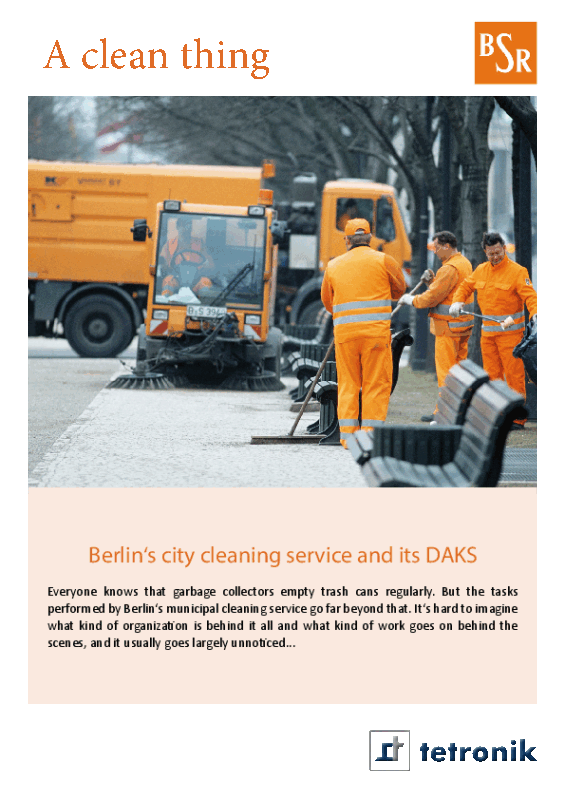
Berlin's city cleaning service and its DAKS

Everyone knows that a waste collection service regularly empties the garbage cans. But the tasks of Berlin's city cleaning service go far beyond that. The organization behind it and the work that goes on in the background can hardly be guessed at and is usually hardly noticed...

Brief introduction to the customer

If you take a look behind the scenes, you will immediately see that Berliner Stadtreinigung (Berlin City Cleaning Service, BSR) is a modern service provider. Owned by the state of Berlin, BSR now has the workforce, expertise, and entrepreneurial flexibility needed to reliably and sustainably meet the waste management goals and cleaning requirements of the German capital.

Its conversion into a public-law institution in 1994 paved the way for a reorientation of the company that meets social and environmental requirements as well as the economic demands of the market.

In this context, group work, which has been practiced throughout Berlin since 1999, has proven to be an extremely efficient solution. This form of work organization makes it possible to keep an eye on critical points at all times and to respond very flexibly to specific cleaning needs.

However, this involves a great deal of coordination, as the task forces have to be constantly reorganized due to vacations, illness, staff arrivals or departures—and, of course, depending on local weather conditions.

Key customer requirements

  • Support the coordination, which was previously done manually, with a server
  • The server should operate from a central location but be supplied with local data in a decentralized manner
  • Compliance with labor law regulations
  • Future link to an SAP system
  • Simplicity and intuitiveness in managing work groups
  • Quick and secure operation of the communication system (approximately 200 employees working in shifts must be able to operate the system)
  • Detailed logging for reporting to the works council

Mr. Hampel

Head of the BSR telecommunications organization
"The person on duty now has much more time for his actual work. Emergencies are almost a routine matter. We can now reach all 2,000 of our street cleaning employees in under 10 minutes. If we compare this with the time we needed before, the system has practically paid for itself from the very first call."
A BSR employee
"If we had a system that worked like an answering machine in reverse, that would be a great help. A computer would have to call all employees who had been assigned to a task by the department head and registered for it until they were actually reached, and then leave a message for each of them."

Mr. Hampel

Head of the BSR telecommunications organization
"We were aware from the outset that our requirements were very high for the BSR department. After all, we also have a very important obligation to ensure that traffic and cleaning, and thus the entire infrastructure, function smoothly."

    The challenge

    In the past, employees were put on standby by telephone when the weather conditions required it and were called in individually as needed. This meant that the operations managers at the respective locations regularly had to call 150 to 300 employees one after the other and continuously update the task forces manually if individual persons could not be reached.

    Implementing individual deployment planning manually often required up to 8 hours of phone calls for each of the 16 shift supervisors, and if, for example, winter weather arrived earlier than predicted, it sometimes meant constant phone calls throughout the night and into the early hours of the morning. For the entire team, this amounted to up to 130 hours of phone calls per deployment.

    The Berlin-based company DOST Telecom, a specialist in communications technology and a long-standing partner of BSR, was consulted. In a joint decision, the tried-and-tested DAKS alarm server was ultimately chosen, as it can be easily integrated into the existing telecommunications infrastructure and meets all requirements.

    "Logging was also very important to us. It was at the top of our list of requirements. Why or for what purpose the shift was requested, and who was contacted for it and when. We submit a detailed report to the works council. We are obliged to do so, and we take this very seriously. Most systems have a logging function that records which number was dialed, but without further details, such as feedback on whether the phone number was incorrect, no PIN was entered, or whether the subscriber did not answer after a certain number of attempts," says Hampel.

    The solution with DAKS®

    Since 2009, employee coordination has been carried out with the support of tetronik's DAKS system. This has not only significantly improved the rapid availability of individual work groups, but has also led to an enormous increase in efficiency, dramatically reducing response times in the event of sudden weather changes.

    “With DAKS, we were able to perfectly map our requirements for a communication server,” explains Mr. Hampel.

    “The protected employee data is provided via a secure connection in DAKS, so that any changes to the phone number are automatically updated.”

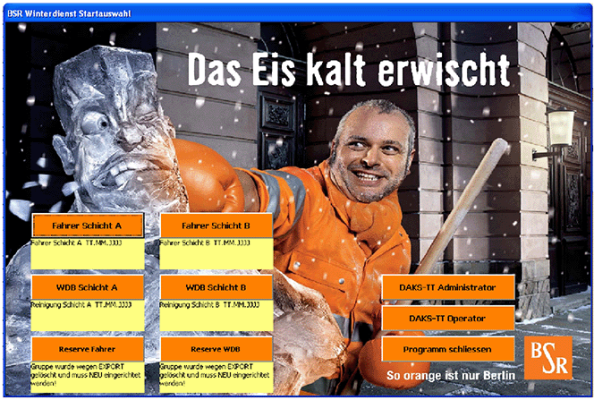
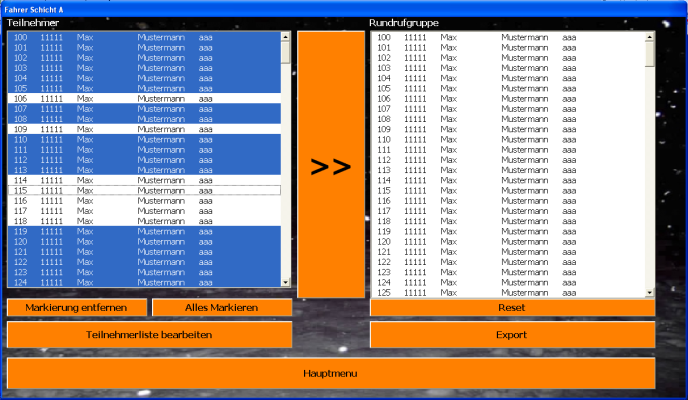
    DOST relied on the powerful 60-channel DAKS to implement the task. Mr. Gehrt from DOST Telecom comments: “After all, in extreme cases, 2,000 participants have to be called, and in as short a time as possible.” He continues: "To simplify the administration of the groups even further, we have expanded DAKS with a specially developed user interface. This allows the working groups to be created and individually maintained from any BSR location and then transferred in bulk to the central DAKS. This saves a lot of time and enables a smooth handover at shift change.“

    Conclusion

    200 fleet managers coordinate 2,000 employees at shift change with a single phone call.

    Mr. Hampel: ”The 200 workstations are fully network-compatible, so that the person on duty can coordinate and execute their work schedule from any BSR location."

    “The system is excellently integrated into the telecommunications infrastructure,” says Mr. Gehrt from DOST Telecom, “everything works together harmoniously. In theory, you could also administer it from home via a VPN tunnel, and even when on the road, a department manager can now mobilize his entire team with a single call to DAKS, even before he has arrived at the office himself!”

    Key components

    The Berliner Stadtreinigung ensures that the individual working groups can be reached quickly by:

    Picture gallery

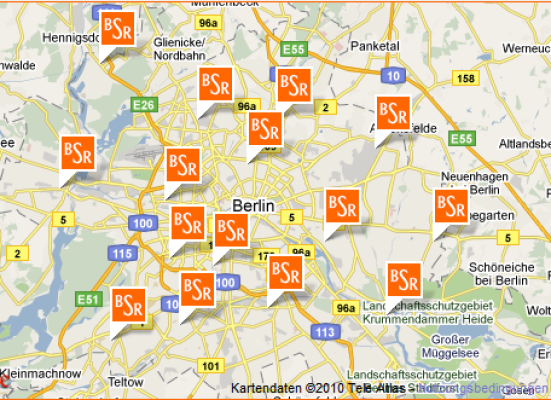
    Map view of Berlin with its BSR locations

    Map view of Berlin with its BSR locations

    Screenshot of the BSR user interface

    Screenshot of the BSR user interface

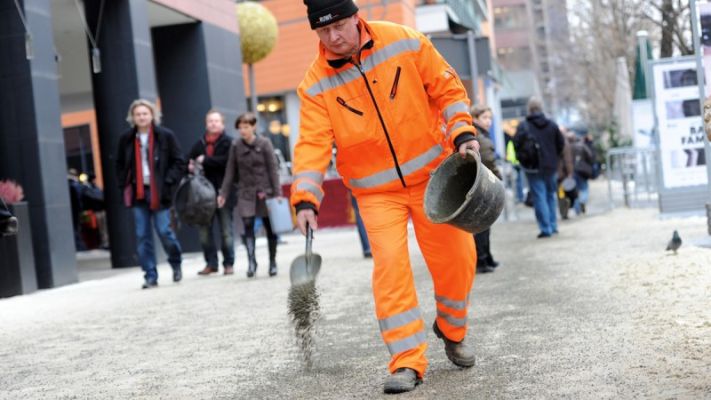
    BSR employee performing winter road maintenance

    BSR employee performing winter road maintenance

    Screenshot of the BSR user interface

    Screenshot of the BSR user interface

      You are looking for a comparable solution?

      Discuss your individual application project with us

      Use watchlist

      Add this solution
      to your watch list