MCI Alerting with DAKS®
A mass casualty incident (MCI) is a situation in which the number of injured people exceeds the capacity for immediate care. Triggers can include traffic accidents, terrorist attacks, war, or environmental disasters. While these incidents fortunately occur rarely, they must be practiced and technically prepared for, as the transition from routine operations to a structured emergency response must take place within minutes.
In an MCI, the focus is not so much on the number of people affected as on a complete system change.
MCI and HICS
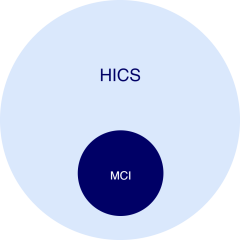
MCI is subordinate to the Hospital Incident Command System (HICS) and is designed to coordinate care in the event of a mass casualty incident. The HICS encompasses crisis management as well as general procedures and guidelines for emergency situations that exceed the scope of daily hospital operations.
The HICS involves the systematic preparation of a hospital for extraordinary events such as fires, cyberattacks, or mass casualty incidents, in order to ensure medical care and safety.
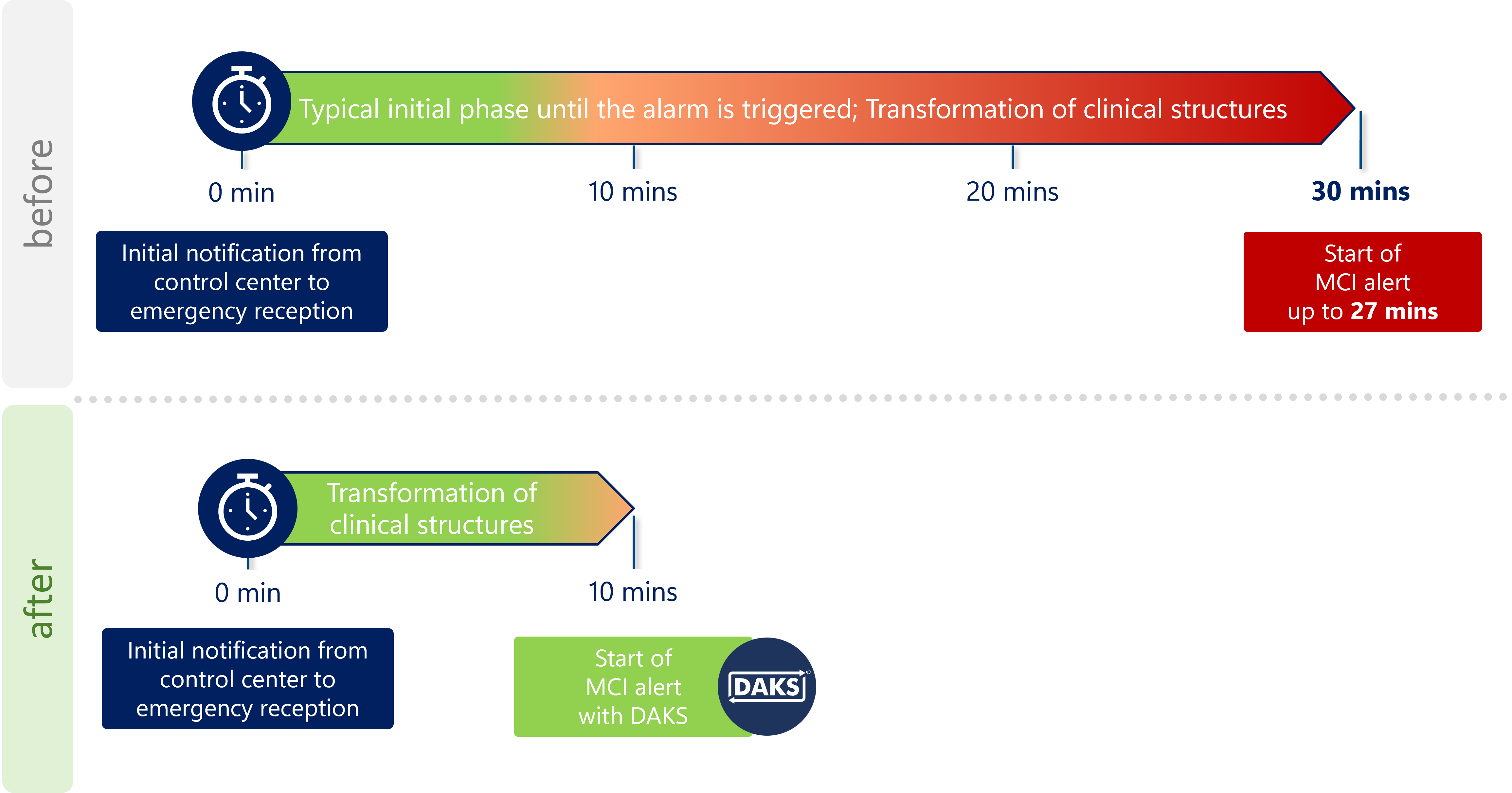
From normal operations to MCI mode: The critical phase of alarm triggering
Especially in large hospitals, the procedures and decision-making processes at the onset of an emergency are becoming increasingly complex. The time pressure to shift clinical operations from routine care to managing an MCI as quickly as possible always places enormous stress on the initial decision-makers.
Often, simply preparing for the alert takes up valuable time, and the subsequent sequence of events is largely unstructured or even chaotic. For example, there are cases where as many people as possible are alerted, and only once everyone is on site is a decision made about who can be assigned to which tasks. In the process, it may turn out that some people were alerted for naught and are not needed at all.
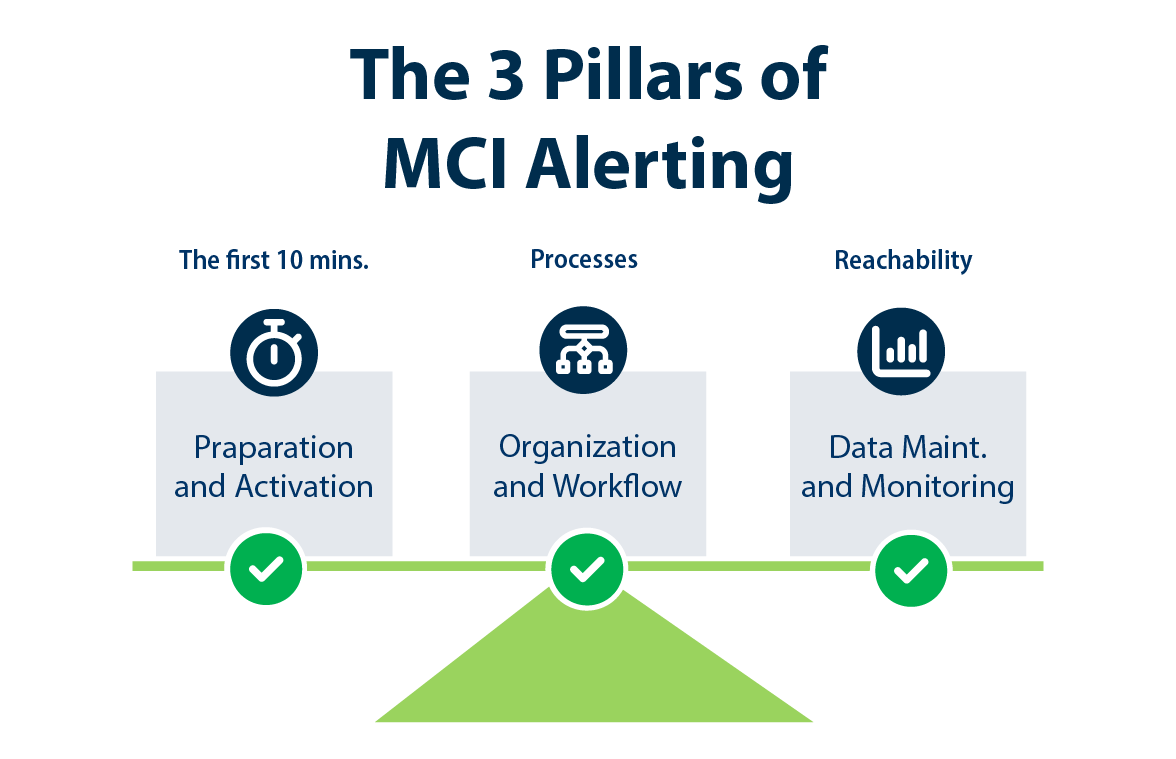
Especially when it comes to MCI alerts, it is important not to overlook the process at large – that is, to also pay attention to preparation and data management. The three pillars of MCI alerting must be in balance, like a scale, so that everything runs smoothly in an emergency and action can be taken quickly.
Videos on the topic
(in German | please use automatic subtitling as needed)
Frequently asked questions about the topic of MCI
Studies show that the first few minutes determine between structure and chaos. An MCI places high demands on a hospital’s processes and communication procedures within a very short time. It is crucial that alert and command structures function reliably even under extreme pressure. Regular drills familiarize staff with the procedures and highlight any potential issues in the established protocols.
Communication problems can quickly arise between the control center, the hospital, the crisis management team, and specialized departments, particularly during mass casualty incidents. Often, a secondary alert is issued if not enough personnel have responded. There is a clear lack of structure in the alerting process.
DAKS helps ensure that data is correctly assigned and that processes are clearly prepared, structured, and monitored. Regular drills are also crucial in this context.
A mass casualty incident can completely change a hospital’s entire care capacity within minutes. To remain capable of responding even when resources are stretched to the limit, coordination must be flexible. Different mass casualty incident levels help with the initial assessment, but personnel, resources, and communication channels must remain flexible to either request additional personnel or transfer patients to nearby hospitals.
The DAKS alarm server provides structure and can very quickly highlight communication gaps during drills.
How does DAKS® help with an MCI implementation?
DAKS helps before, during, and after an MCI alert
Without DAKS, procedures in the event of a mass casualty incident are often not clearly structured. The transition from normal to emergency operations takes a long time, alerts are delayed, and often more people are alerted than are ultimately needed. This results in unnecessary delays in incident coordination.
DAKS clearly defines processes and standardizes procedures, which significantly speeds up the alerting process. Only the individuals and departments required for the specific situation are notified. At the same time, logging all actions ensures transparent traceability of the procedures.
The benefit is particularly evident in the response time: While the alert phase without DAKS typically begins only after 27 minutes, with DAKS the alarm can be triggered as early as approximately ten minutes after the notification reaches the emergency reception. This allows all necessary preparations for the patients’ arrival to be made early and efficiently. DAKS also plays a crucial role after the alert is issued, as all calls and procedures are automatically logged.
(Source: Click here)
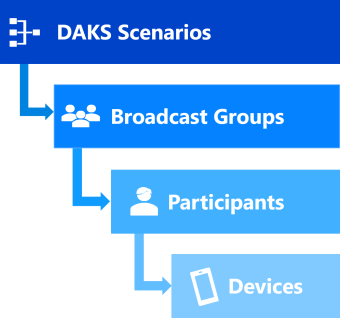
Mapping and implementing key communication processes
The following structure has proven effective for modeling mass casualty incidents and user groups in the DAKS system: DAKS scenarios include broadcast groups, which in turn contain the various participants; each participant has one or more end devices. This multi-level structure makes it possible to model all conceivable MCI flexibly and directly.
| Required functionality | How it is implemented in the DAKS logic |
|---|---|
HICS/MCI levels | Use of DAKS scenarios |
Classification/Situation | Organization into broadcast groups |
Classification by specialty group (technicians, medical specialists, etc.) | Assigning participants to skill and function groups |
Connection types | Assigning devices to participants |
Data maintenance: a key factor for success
If an MCI drill does not go smoothly, it is often because emergency response plans and procedures are not updated frequently enough. In smaller hospitals, it can happen that insufficient precautions are taken even during preparatory measures for internal emergencies, such as the failure of technical equipment.
Common sources of errors in MCI alarms include outdated phone numbers, employees who have left the company, changes in devices, missing updates, and incomplete assignment of data and tasks. The solution: regular drills and regular data maintenance and updates. Drills reveal exactly where processes need to be optimized, they familiarize employees with the workflow, establish routine, and put established procedures to the test.
Our data import tool offers even more benefits. It ensures fully automated import of your existing data – and creating a template just once is all it takes to keep your system updated with current, reliable data going forward.
MCI "Comfort Package(s)"
HICS/MCI can be implemented using DAKS as part of the standard scope of DAKSpro V9, which includes the Broadcasting & Alertingand Conferencingas well as an on-call service number.
Depending on your needs, various comfort packages are also available, for example:
- for 'Visualization and Performance' with DAKS IoT dashboards, on-call profiles, and Text-to-Voice,
- for 'Organization and Workflow' with scenarios and function groups, or
- for 'Automated Data Management' via data import and management of over 3,000 subscribers.
Additionally, other components such as digitized trauma room alertingor a citizen hotlinecan be integrated.
DAKS Modules for HICS / MCI: What do you need for implementation?