
© tetronik GmbH. All rights reserved.
In hospitals, every second counts. Clinical processes related to patient care and emergency treatment depend on reliable, fast communication channels to ensure that those affected can be helped successfully.
In many emergency procedures, response times are also specified: in the case of an emergency C-section – the most high-priority clinical emergency – a maximum of 20 minutes may elapse between the time when the fetus's oxygen deprivation is detected and the moment when the child is finally delivered from the womb by C-section. DAKS customers have even been able to reduce the average response time to less than ten minutes by using DAKS – despite having to cover distances across buildings to reach the special emergency C-section operating room.
Read also: Obstetricians at the University Hospital of Halle perform emergency C-sections in less than ten minutes on average (available in German)

When speed is of the essence, effective and proven processes are indispensable.
DAKS also provides support in the operating room with additional scenarios. Using an intuitive emergency call trigger, the surgical team can request additional specialist personnel for support if necessary. In this way, DAKS enables the sensible linking of individual, related alarm applications.
Corresponding intercom stations are usually located in operating rooms, delivery rooms, and emergency rooms. If necessary, a spontaneous announcement can also be recorded for the emergency call. This is a real added value, as it allows the doctors who are called to prepare for the task at hand without wasting any time: even while they are on their way to the scene, they already receive important information about what to expect there and what equipment they may need to bring with them.
Some hospitals have even used DAKS to digitize their emergency room admission forms. DAKS automatically generates an announcement based on the information entered in the form, which the emergency room staff can then send to the relevant doctors at the touch of a button. You can find out more in our application example: Automate Trauma Room Alerting.
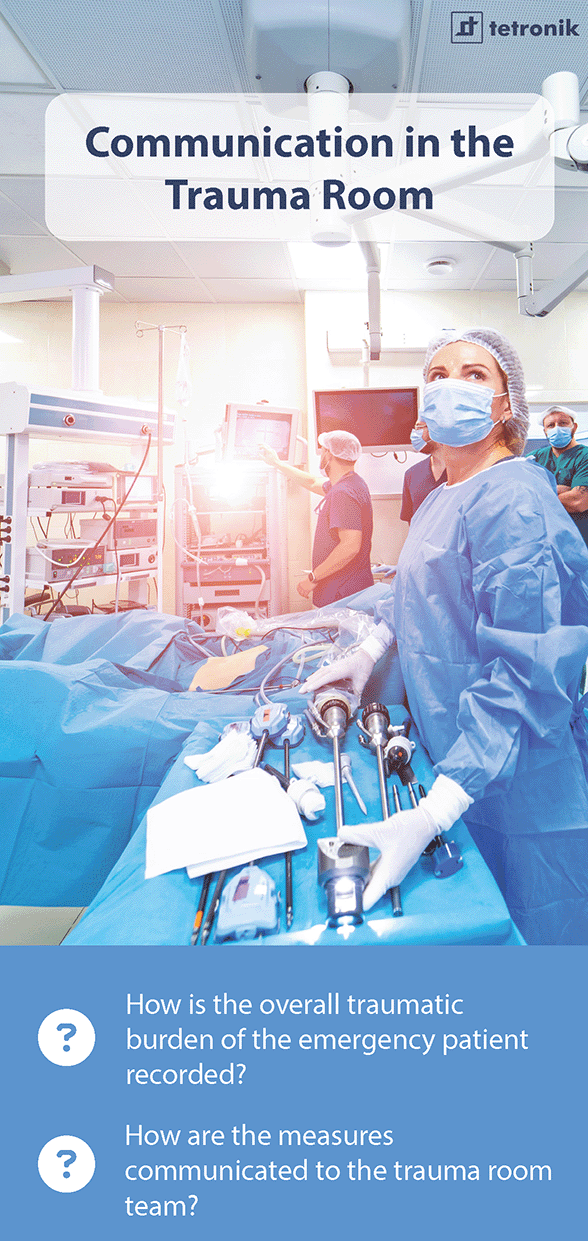
DAKS also makes life much easier for trauma centers. In the event of a serious traffic accident, for example, DAKS first connects the rescue control center, rescue transport, and hospital admissions department in a conference call, enabling the effective transfer of all important information about the patient who is about to arrive.
The doctor called from the emergency room then uses a speed dial button to trigger an internal polytrauma call to all necessary personnel. Intuitive handling is important so that the right action can be taken even under stress and delays can be avoided at all costs. The call specifically requests certain specialist areas depending on the nature of the injuries: it's not just doctors who are needed here! The arrival of the ambulance must be organized and the rescue route secured by targeted blockades. The trauma room must be prepared and capacity made available in the wards.
Security personnel, the emergency room team, operating room occupancy managers, surgeons, anesthesiologists, radiologists, and many other specialists must be brought on board quickly and effectively in such cases and provided with information so that everything runs smoothly. Thanks to DAKS, all parties involved can be reached optimally: The call receives the highest priority and can therefore interrupt less important calls and draw attention to the urgency of the call with a special ring tone.
Read also: Organize Emergency Operations Quickly and Effectively
Once the emergency process is complete, log files of the alarm calls are automatically sent to the responsible parties. DAKS records the call sequences in detail in the log file: what data was transmitted and who responded when and how. The evaluations of the DAKS processes can be accessed at any time and are very valuable for quality control. They serve as proof of quality and as a basis for continuous process optimization, but are also important documents if a clinic needs to be held legally accountable.
DAKS provides optimal support for conducting alarm drills. DAKS customers can rehearse complex alarm scenarios as often as they deem appropriate without incurring any costs on the part of DAKS. Whether it's a mass casualty incident (MCI) or an evacuation, regular practice is important so that everyone involved has internalized the important procedures and everything runs smoothly in an emergency. In addition, the detailed DAKS protocol used in the drill reveals exactly which weak points still need to be optimized.
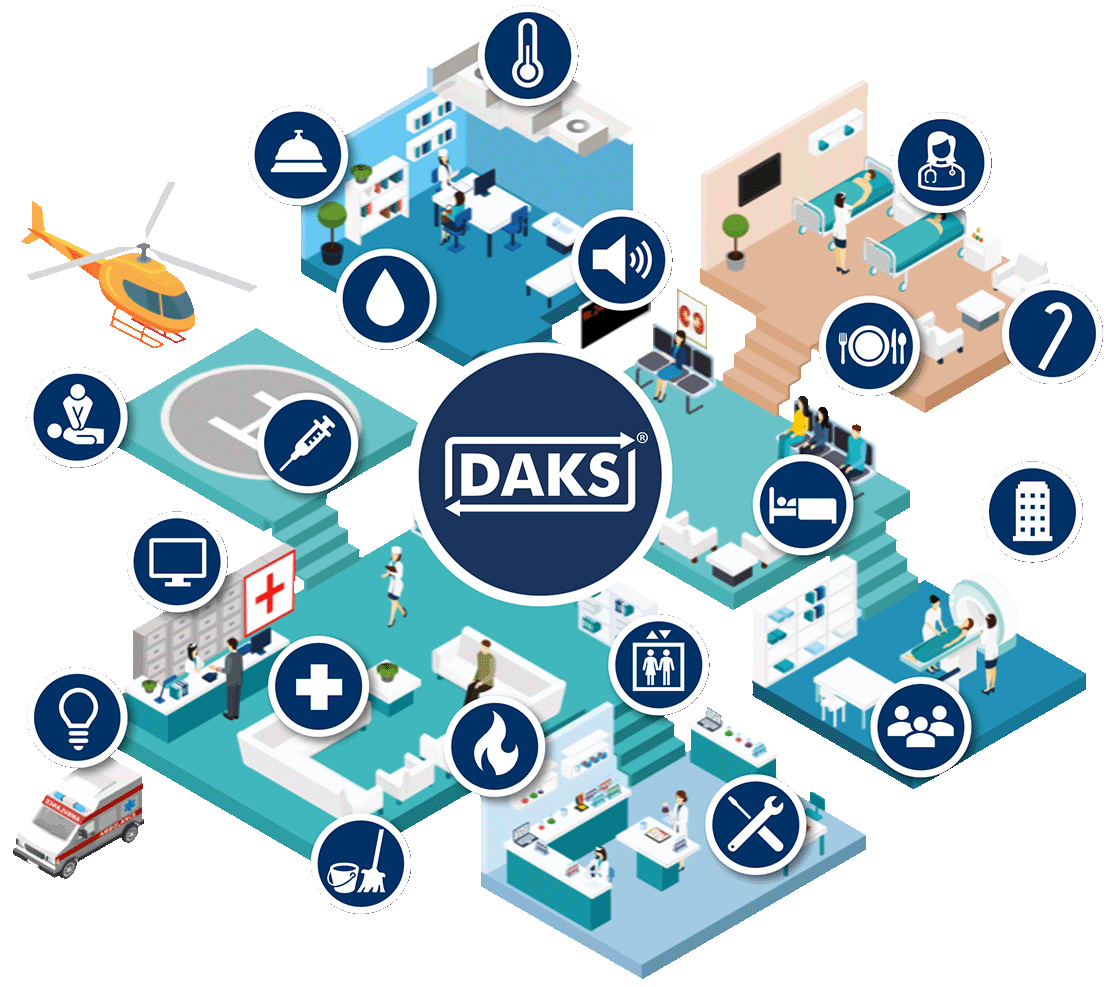
DAKS optimizes a wide variety of hospital processes

While optimized patient care and, ultimately, patient safety are the top priorities in all emergency scenarios, the economic benefits of the DAKS solution for hospitals should not go unmentioned.
In the operating room in particular, every hospital benefits from DAKS thanks to a much more effective use of its capacities. After all, you want to make optimum use of the most expensively equipped area of the hospital. It also makes a significant financial difference how quickly surgical teams can be organized and – in the event of a sudden emergency operation – reorganized with the help of DAKS call processes. With DAKS, the complex organizational processes involved in operating room management can be carried out at the touch of a button to make the operating rooms available for use – a feature that many DAKS customers in the healthcare sector are enthusiastic about.
See also our application example: Organize Emergency Operations Quickly and Effectively
DAKS has multiple applications in the hospital sector. DAKS optimizes important processes in many different areas and can be scaled flexibly. All alert scenarios can be individually tailored to the respective hospital processes and requirements.
It's not always just about emergency alerts – the DAKS application modules cover a large part of clinical communication needs and can therefore also facilitate everyday coordination processes or on-call planning, for example. Once DAKS has been purchased, for example for connecting light call systems, it can be expanded for other uses and applications at any time, thereby multiplying its benefits.
DAKS also integrates a wide variety of technologies – from simple door contacts in building management to specialized hospital systems and smart sensors – thus connecting different technological worlds. This allows systems to be updated gradually and investments to be better aligned with budgets.
What can DAKS do for your hospital?
Talk to one of our trained system dealers and get personalized advice.
© tetronik GmbH. All rights reserved.